
Every day, businesses across Nigeria make decisions. Some of those decisions grow the business. Some of them cost it — dearly. The difference between the two is rarely luck, talent, or even experience.
The difference is data.
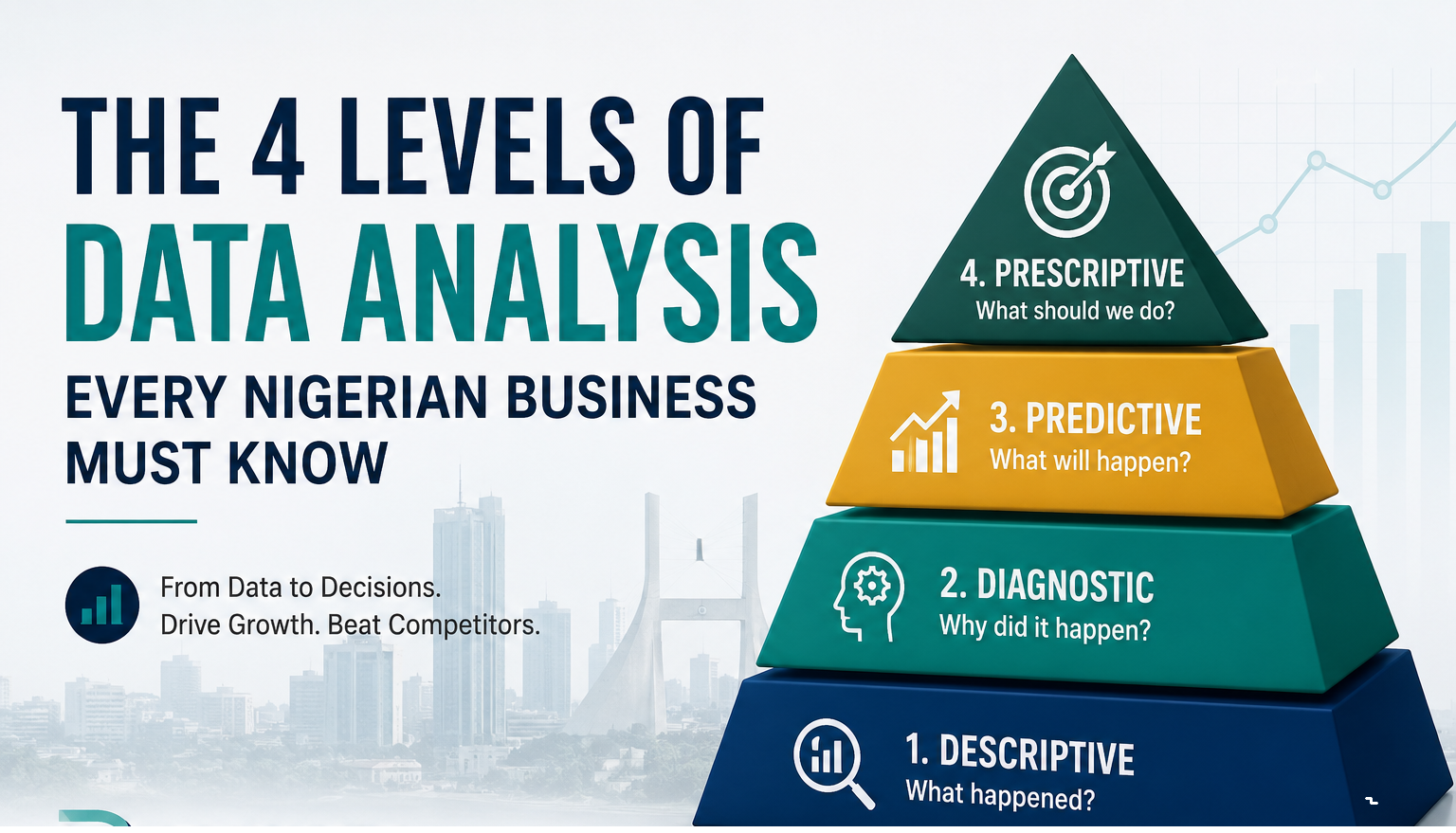
But not all data analysis is equal. There are four distinct levels — and where your business sits on this ladder determines the quality of every decision your leadership makes. Understanding these four levels is the first step toward building a data-driven organisation that grows with clarity, not guesswork.
Let us walk through each one.
Level 1 — Descriptive Analysis
The Question It Answers: What happened?
Descriptive analysis is the foundation of every data-driven organisation. It summarises your historical data to tell you exactly what occurred in your business — total revenue, best-selling products, busiest days, top-performing branches, and average transaction values.
This is the most common type of analysis — and paradoxically the most overlooked. Most businesses have the raw data sitting in their systems right now. Very few have organised it into clear, readable summaries that leadership can actually use.
Real example from Dr Analyzer:
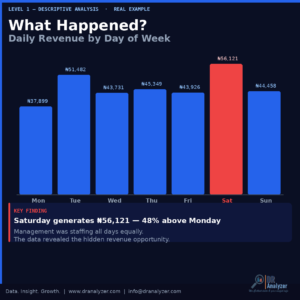
We analysed 1,000 supermarket transactions across 3 branches. Descriptive analysis immediately revealed that Saturday was the highest revenue day at ₦56,121 — 48% above Monday. The management team had no idea. They were staffing all days equally.
If your business cannot quickly answer “what were our top 5 products last month” or “which branch made the most money last quarter” — you are not yet operating at Level 1. That is where Dr Analyzer starts.
Level 2 — Diagnostic Analysis
The Question It Answers: Why did it happen?
Knowing what happened is valuable. Knowing why it happened is powerful. Diagnostic analysis drills below the surface numbers to uncover the root cause behind every result — good or bad.
This is where most businesses hit a wall. They can see from their reports that revenue dropped in August. But they cannot explain why. Was it seasonal demand? A competitor promotion? Staff performance? Product availability? Pricing changes? Without diagnostic analysis, the honest answer is — nobody knows.
Real example from Dr Analyzer:
In the same supermarket analysis, we found that Health and Beauty 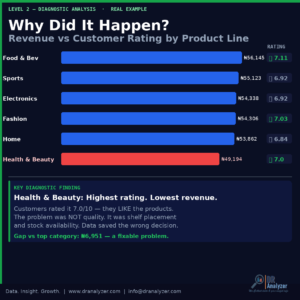 was underperforming by ₦7,000 compared to every other category. Descriptive analysis showed the gap. Diagnostic analysis revealed why — customer satisfaction ratings for Health and Beauty were actually 7 out of 10 — one of the highest scores. The problem was not product quality. It was shelf placement and stock availability. Customers wanted the products. They just could not find them.
Without diagnostic analysis, the management team might have discontinued the category entirely — eliminating a revenue stream that simply needed better positioning. Data saved that decision.
Level 3 — Predictive Analysis
The Question It Answers: What will happen?
This is where data analysis becomes genuinely transformational. Predictive analysis uses your historical patterns — trends, seasonality, growth cycles, and anomalies — to forecast what is likely to happen in the future with statistical confidence.
Instead of reacting to what already happened, your leadership team begins planning for what is coming. Budget decisions, staffing plans, stock orders, and marketing campaigns all become evidence-based rather than instinct-driven. The business stops being surprised — and starts being prepared.
Real example from Dr Analyzer:
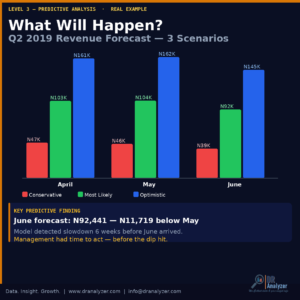 Using AI-powered forecasting on the supermarket data, we predicted Q2 revenue across three scenarios. The most likely forecast was ₦300,345 for the quarter — but the model detected a slowdown pattern that pointed to June being significantly weaker than April and May. This gave management 6 weeks of advance warning to act — before the dip arrived.
At Dr Analyzer, we use the same machine learning forecasting models that global corporations use — making this level of intelligence accessible to every Nigerian business, regardless of size.
Level 4 — Prescriptive Analysis
The Question It Answers: What should we do about it?
This is the highest value type of analysis — and the one that Dr Analyzer considers the non-negotiable output of every engagement. Prescriptive analysis does not just tell you what happened, why it happened, or what will happen. It tells you exactly what to do about it.
Specific actions. Assigned owners. Realistic timelines. Measurable targets. This is what separates a data analytics firm from a reporting service. Reports describe. Prescriptive analysis decides.
Real example from Dr Analyzer:
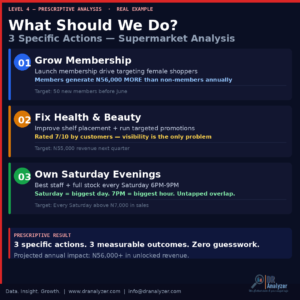 From the same supermarket analysis, our prescriptive recommendations were: (1) Launch a membership drive targeting female shoppers — members generate ₦56,000 more than non-members annually. (2) Improve shelf placement for Health and Beauty — rated 7/10 by customers but ₦7,000 behind the top category. (3) Deploy best staff and full stock every Saturday from 6PM to 9PM — Saturday is the biggest day and 7PM is the biggest hour. Three specific actions. Three measurable outcomes. Zero guesswork.
This is the level where data analysis pays for itself — many times over. One right decision, made because of evidence rather than assumption, can generate more value than years of gut-feel management.
Where Is Your Business Right Now?
Here is the honest truth about the Nigerian business landscape: the vast majority of businesses — including many large, established organisations — are operating at Level 1 or below. They know their total sales. They may know their best product. But they cannot explain why performance changed, predict what is coming, or identify the specific actions that would move the numbers.
This is not a criticism — it is an opportunity. Because every business that moves up even one level on this ladder gains a significant, compounding advantage over every competitor that stays behind.
The businesses growing fastest in Nigeria today are not always the biggest, the oldest, or the best-funded. They are the ones making the best decisions — consistently, quickly, and based on evidence.
How Dr Analyzer Moves You From Level 1 to Level 4
At Dr Analyzer, every engagement is designed to deliver all four levels of analysis — not just a summary of what happened, but a complete intelligence package that tells your leadership team what happened, why it happened, what is coming, and exactly what to do about it.
We combine the judgment and business thinking of experienced human analysts with the speed, scale, and precision of advanced AI-powered tools — giving your business access to the kind of intelligence that was once available only to large corporations with dedicated analytics departments.
Our services cover every level:
● Business Performance Analysis — Level 1 and 2
● AI-Powered Revenue Forecasting — Level 3
● Customer Intelligence Reports — Level 2 and 3
● Executive Dashboard Creation — Level 1, 2 and 3
● Boardroom Presentations and Reports — Level 4
Every engagement is handled with strict confidentiality, delivered within 3 to 7 business days, and built entirely around your specific business, your industry, and your strategic goals.
The Question You Should Be Asking Today
Not “do I need data analysis?” — every business does.
Not “can I afford it?” — the cost of a wrong decision always exceeds the cost of the analysis that would have prevented it.
The question is: which level is my business operating at right now — and what decisions am I making today that better data could improve?
If you are ready to find out — Dr Analyzer is ready to help



No responses yet